Our taxi pulled over on the side of the road in Wadi Rum next to the only pickup truck in sight.
We were surrounded by orange sand stretching in every direction, broken only by scattered desert bushes and towering gray rock formations. It looked nothing like any landscape I had ever seen before.
A man dressed in traditional Bedouin clothing greeted us with a warm smile.
“Welcome,” he said.
His name was Atif.
He pointed toward the back of the truck, where two iron benches covered with colorful cushions waited for us. We tossed our bags into the back and climbed aboard.
A few moments later we were bouncing across the desert, smiling the entire way. We could hardly believe our luck. Wadi Rum hadn’t been part of our original itinerary, but Pavel’s curiosity had prompted our taxi driver to call a friend who ran a Bedouin camp in the desert. An hour later, we found ourselves here.
At first we followed the road, but suddenly the truck turned off the pavement and continued into the desert along a barely visible track.
A little later we stopped in front of a massive rock formation rising from the desert floor. It looked like a stack of pillars leaning against each other. Atif pulled out a park entry ticket and pointed to the same formation pictured on it: the Seven Pillars of Wisdom, one of Wadi Rum’s best-known landmarks.
Along the way we passed a large group gathered around a rock covered with ancient petroglyphs, while their camels rested in the sand nearby. A little farther on, we passed two young boys walking through the desert with their camels. I was surprised to see them wearing jeans, sweaters, and even puffy vests in the desert heat.
We hadn’t gone much farther when our truck became hopelessly stuck in the sand. Atif and our second guide, Hazem, calmly climbed out of the truck. Pavel and I immediately asked how we could help, but they waved us off and told us to stay where we were.
They let some air out of the tires, then called to the two boys we had just passed, who came running over to help push the truck until we were moving again.
I sat there feeling rather useless and secretly thinking that pushing a truck out of the desert sand would have been part of the adventure.
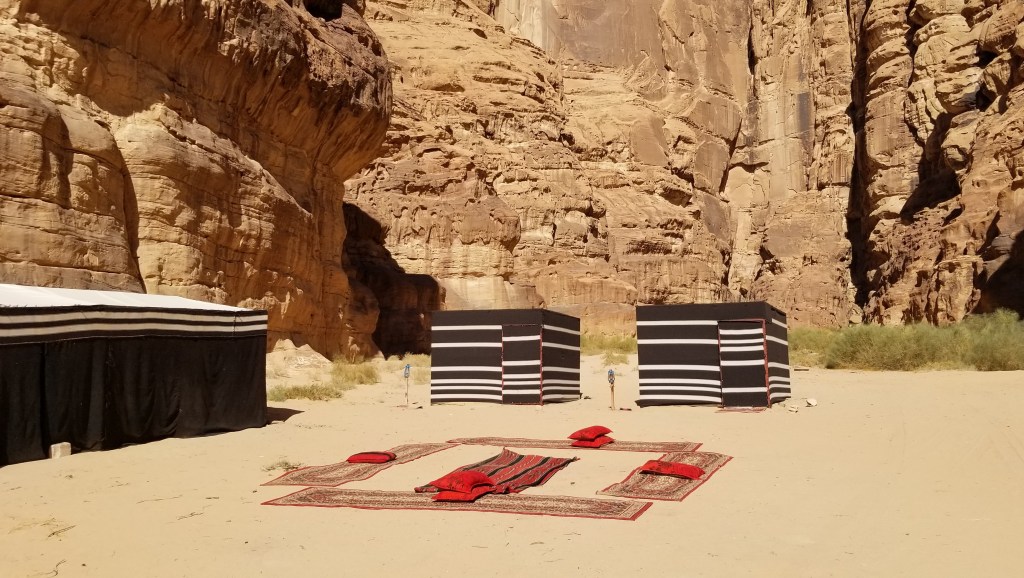
Soon we arrived at a small Bedouin camp tucked against a towering sandstone wall.
Square black-and-white tents stood quietly in the shade of the canyon. It felt noticeably cooler there, and except for us, the camp seemed completely empty.
Without saying anything, Atif walked toward a shaded sitting area with benches and carpets spread across the sand. He arranged blankets and cushions on the benches, then dropped a couple of pillows onto the carpet for us to lie down.
“Welcome. Relax.” He said and then he disappeared.
A few minutes later he returned and, seeing that we were still standing confused, smiled again.
“Relax.”
He offered to make tea. While Pavel helped him gather branches for the fire, I did what I always do. I sat down on the carpet and pulled out my journal.
Atif set a small black teapot over the fire and sat down in the sand.
“You’re writing a lot. Relax.” He said
I laughed, but I couldn’t put the journal away. Too much had already happened that day, and I wanted to capture it before I forgot.
Pavel sat next to Atif in the sand, and before long the two were chatting and laughing like old friends. At some point Atif whispered something to Pavel, and they both burst out laughing.
It was a secret between men, between friends. Naturally, I wanted to know. Eventually they let me in on the secret: according to Atif, camel milk could help with all kinds of men’s problems. At that point, I wished I’d never asked.
As it turned out, though, it wasn’t entirely a joke. Camel milk has been used for centuries in traditional remedies among Bedouins and other communities in the Middle East.
When the tea was ready, I put my journal aside and joined them by the fire. Atif poured the tea into small glasses and placed them in the sand in front of us.
The tea was sweet but wonderfully fragrant.
He offered us round yellow cookies filled with a brown paste.
“What’s inside?” I asked.
He looked at the cookie, shrugged, and smiled.
“Don’t know. It is cookie. I eat.”
I still laugh every time I think about that answer.
As I sipped my tea and ate the cookie, I couldn’t help thinking how peaceful it was there. Everything seemed to slow down. Even something as simple as making a cup of tea had become a ritual worth watching. Surrounded by Wadi Rum’s strange, almost moonlike landscape, the rest of the world suddenly felt very far away.
At some point, Atif pulled out his cellphone to show us pictures from trips with previous guests. It was only then that I realized how quickly I had disconnected from the modern world. Somehow, after only a few hours in the desert, a cellphone seemed out of place. Before long, though, we were exchanging pictures and we all became Facebook friends.
Our conversation was suddenly interrupted by a beautiful chirp from somewhere above us. A black bird with white wings sat on a rock overlooking the camp, whistling and chirping while we sat quietly and listened. Then, as quickly as it had appeared, it was gone.
Hazem, our second guide, had joined us by then. Together, he and Atif led us through Wadi Rum, making us feel less like tourists and more like friends spending the day together.
The rest of the afternoon passed in a blur of unforgettable moments. We rode camels, drove across the desert in Atif’s pickup truck, climbed towering rock formations, wandered through soft orange sand dunes, and watched the sun slowly sink behind Wadi Rum’s magnificent sandstone cliffs.
By the time we returned to camp, dinner was waiting.
A carpet had been spread across the sand, and we all sat cross-legged in a circle around a single enormous platter of rice, vegetables, chicken, and even cooked pickles.
Before anyone took a bite, Atif poured a light-colored sauce over the entire platter. Then I watched as he and Hazem effortlessly gathered small handfuls of rice, forming them into little balls with one hand before eating them.
It looked incredibly easy. Pavel and I quickly discovered it wasn’t.
As we laughed at our clumsy attempts, Atif quietly picked up a piece of chicken and tossed it onto my side of the platter. A moment later, he added a pickle.
“Eat,” he urged.
He reminded us that Ramadan would begin tomorrow, a month of fasting from the first light of morning until sunset. No food, no water. After the day we’d just spent in the desert heat, I couldn’t imagine how they did it.
Atif, meanwhile, was determined to make sure we ate enough before the fasting began. So we ate.
Then we ate a little more.
Eventually we insisted we couldn’t possibly fit another bite.
Atif suddenly stood up and disappeared into the darkness. When he returned a few moments later, he announced that Ramadan had been postponed.
We all burst into laughter… and somehow managed another few bites.
The evening slipped by as we drank tea, shared stories, and lay back on the carpet looking up at a sky filled with stars.
As the night grew quieter and the jokes slowly faded, we watched quietly as Atif offered his evening prayer.


Leave a Reply