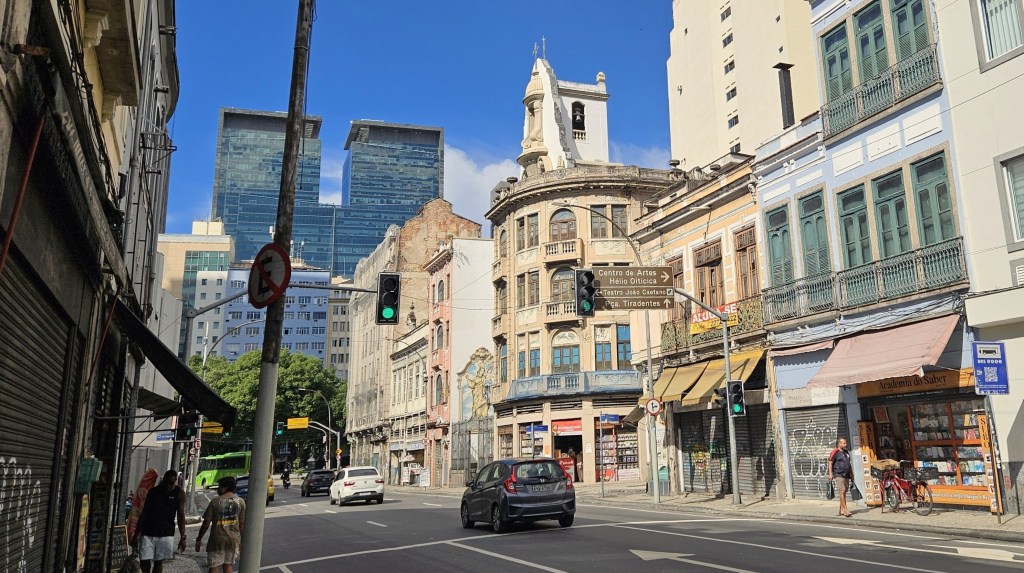
When I think of Rio de Janeiro, I picture Sugarloaf Mountain, the golden beaches of Copacabana and Ipanema, and Christ the Redeemer watching over the city. But I realized I knew very little about downtown Rio. So on the last day of our trip, I decided to join a free walking tour and explore its streets for myself.
We met beneath the Carioca Clock, a beautifully carved cast-iron clock standing along Avenida Rio Branco, once known as Rua Carioca, one of downtown’s main streets. I was immediately drawn to the ornate sculptures at its base and feeling a little disappointed that the clock itself was no longer running. It seemed like such a fitting place to begin a walking tour through the city’s history.
Almost immediately, we learned two fascinating facts about Rio. The first was that people born in Rio are known as Cariocas. The word comes from the Indigenous Tupi language and originally referred to the “house of the white man,” a reference to the first Portuguese settlers. Today, however, it means much more than simply someone from Rio. It represents the city’s easygoing rhythm of life, its beaches, music, and the unique culture that makes Rio feel unlike anywhere else. After spending a week in Rio, I thought the description fit perfectly.
The second fact made me smile even more.
Rio de Janeiro literally means “January River.” Portuguese explorers gave the city its name after arriving in January 1502, believing they had discovered the mouth of a river. They were wrong. It was actually a bay, but the name remained.
I had a feeling this was going to be an interesting tour.
Our guide was a young woman, deeply passionate about the city’s history. Her enthusiasm and energy brought the city to life for me. Our group hardly spoke as we quietly followed behind her, fascinated by the stories she shared at each stop.
My first impression of downtown, however, wasn’t particularly encouraging.
Some streets looked neglected. Graffiti covered walls, and at one historic church it had even been sprayed across the sculpted figures beside the main entrance. I remember wondering why the city didn’t simply clean it up. Later, I noticed construction crews renovating several streets and learned that parts of the historic district were gradually being restored.
As we continued walking, the city began to surprise me.
One moment we were surrounded by modern glass office towers. A few minutes later we found ourselves standing among beautiful colonial buildings decorated with ornate balconies and colorful façades. I hadn’t expected to find architecture like that in Rio at all. Every few blocks, the city seemed to become something different.
The contrasts continued everywhere we walked. Historic churches stood beside modern skyscrapers. Beautifully restored buildings shared the streets with walls still covered in graffiti. Every turn revealed another layer of the city’s history.
One of the places I had been looking forward to seeing was Confeitaria Colombo, one of Rio’s most famous cafés. Even before it opened, a long line of people had already gathered outside. Inside, towering mirrors, beautifully carved wooden display cases, ornate ironwork, and warm lighting made it feel more like an elegant ballroom than a bakery. I would have happily stayed for coffee and pastries, but our guide was already leading the group toward the next stop.
Along the way, she shared stories that turned an ordinary walk between buildings into a journey through Rio’s past. One of my favorites was the legend of Empress Teresa Cristina, who was forced to leave Brazil after the monarchy was overthrown. Legend says that before boarding the ship into exile, she removed her shoes, saying she didn’t want to take even a grain of Brazilian soil away with her.
I immediately pictured her standing on the deck of an old steamship in a long Victorian dress, wearing an elegant hat and dramatically tossing her shoes overboard. I have to admit, the image made me smile, even though the story itself was a little sad.
Another stop introduced us to the work of Indigenous Brazilian artists. Inside the small gallery, woven baskets lined the shelves, hand-carved wooden paddles and flutes hung from the walls, and intricate patterns decorated everything from bowls to textiles. I was surprised to learn that Indigenous communities across Brazil continue to preserve their artistic traditions to this day. It was something I hadn’t expected, and I found myself lingering a little longer, admiring the artwork on display.
We continued our walk. By early afternoon, the heat was beginning to take its toll. Although Brazil was slowly heading into winter, Rio still felt surprisingly hot. After several hours of walking, all I could think about was finding a cool place to sit. When I spotted a small café along the route, the smell of freshly brewed coffee drifting through the open door was impossible to ignore. For a moment, I seriously considered slipping away from the tour. Just then, our guide smiled and announced that we were almost at the final stop. I decided to power through.
Our final stop was the Municipal Theater, considered one of the most beautiful and important theaters in Brazil. It was easy to see why our guide had chosen to end the tour there. It really was spectacular. We gathered on the wide front steps for one last group photo before saying our goodbyes.


Leave a Reply