Most mornings in Rio began the same way.
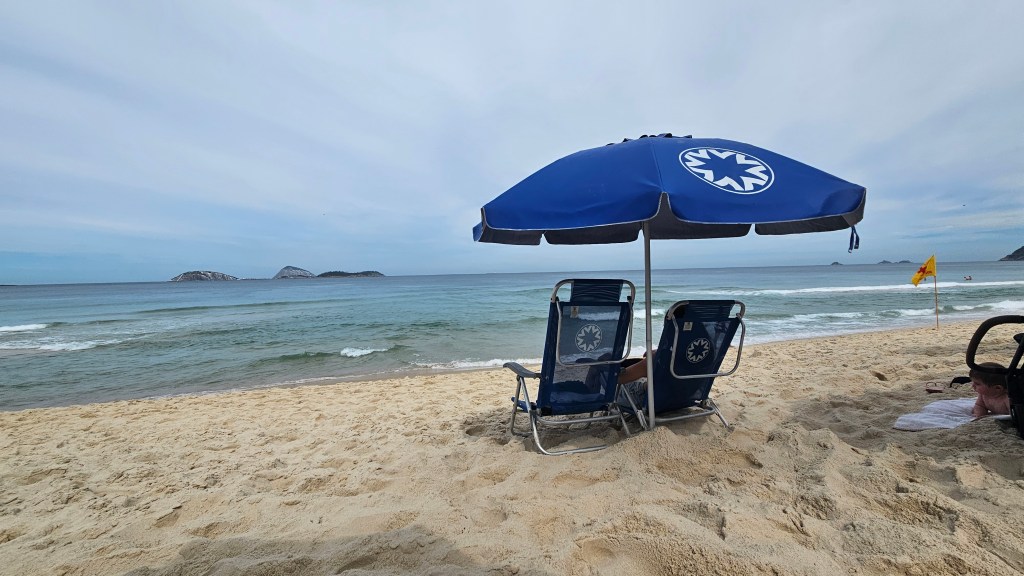
Just after six o’clock, I’d cross the street from my hotel and step onto the sand at Ipanema Beach. The city was only beginning to wake up, and the beach still belonged to the early risers.
The air was cool and crisp, the waves rolled gently onto the shore, and only a handful of people had arrived. In the distance, volleyball and footvolley lessons were already underway, while neatly stacked beach chairs and folded umbrellas waited quietly for the day ahead.
Sometimes I’d take a walk along the water before settling into my chair. Other mornings I couldn’t resist kicking off my sandals and sinking my feet into the warm sand right away. There really is no better feeling than warm sand between your toes. With Two Brothers Mountain rising above the shoreline in the distance, it was a view I never grew tired of.
By eight o’clock, the beach began to transform.
Umbrellas appeared one by one until they seemed to cover the sand in every direction. More people arrived. Swimmers headed into the ocean. Joggers made their way along the shoreline.
And then came the vendors.
Some carried colorful Brazilian bikinis draped over large hangers. Others balanced coolers filled with cold drinks. A few pushed small portable grills, ready to cook fresh skewers right there on the beach. They called out what they were selling as they wandered between the chairs.
“Mate!”
“Maracujá!”
At first, I found it almost impossible to relax. Every few minutes another voice drifted past my chair, advertising drinks, snacks, blankets, or souvenirs.
But something funny happened over the next few days.
The calls slowly became part of the soundtrack of the beach. Instead of noticing how often they passed by, I found myself listening to what they were saying. Before long I was recognizing the words and smiling as I understood what some of the vendors were offering.
It no longer felt noisy.
It simply felt like Rio.
One thing I especially enjoyed watching was footvolley, a uniquely Brazilian combination of soccer and volleyball. Every morning the courts were already busy, and by afternoon they were packed with games.
The players made it look effortless, keeping the ball in the air using only their feet, chest, shoulders, and head before sending it gracefully over the net. I often paused during my walks just to watch for a few minutes. As much as I admired the skill, I have to admit I’d still choose volleyball every time.
The first few mornings, however, the ocean demanded even more attention than the games.
A hurricane had passed just before we arrived in Rio, leaving behind enormous waves that crashed onto the shore with incredible force. Red flags warned swimmers about the dangerous conditions, and I watched several people rescued by lifeguards on rescue boards. Their speed and awareness were impressive. By the time I realized someone was in trouble, the lifeguards were already halfway there.
One man was led back onto the beach by a lifeguard holding his hand.
I couldn’t help smiling.
As the week went on, the sea calmed down. The skies turned bright blue, the waves became gentler, and the beach settled into the peaceful rhythm I’d imagined before arriving.
Every morning became a little ritual: a walk along the shore, a few minutes watching footvolley, the familiar calls of the vendors, and Two Brothers rising above the beach in the distance.


Leave a Reply